Leave Your Message
China has become a major sourcing base for compact refrigeration components, including the Mini Fridge Compressor. Manufacturers serve hotel rooms, dormitories, offices, vehicles, laboratories, and outdoor applications. Their products differ in cooling capacity, refrigerant compatibility, noise level, energy use, and production consistency.
Industry reports show why compressor selection deserves closer attention. The IEA and UNEP report, The Future of Cooling, warns that global cooling demand could more than triple by 2050 without efficiency improvements. The 2024 Global Status Report for Buildings and Construction also highlights rising pressure to reduce building energy consumption. These findings make compressor efficiency more than a technical preference. It affects operating cost, battery life, heat output, and long-term reliability.
Small cabinet. Tight tolerances.
This guide examines leading Chinese manufacturers through practical purchasing criteria. These include compressor displacement, cooling performance, COP data, starting current, vibration control, refrigerant options, and certification records. Factory experience also matters. A supplier should explain its testing process, oil selection, temperature range, and warranty response clearly. Reports from Grand View Research and MarketsandMarkets indicate continued growth in refrigeration compressor demand, although their market definitions and forecasts vary. That difference deserves caution.
No supplier ranking stays permanently correct. A factory may offer excellent bulk pricing but weaker technical support. Another may provide strong laboratory data but limited customization. Therefore, this comparison focuses on verifiable capabilities rather than promotional claims. Buyers should request test reports, sample units, production references, and current compliance documents before making a final decision.
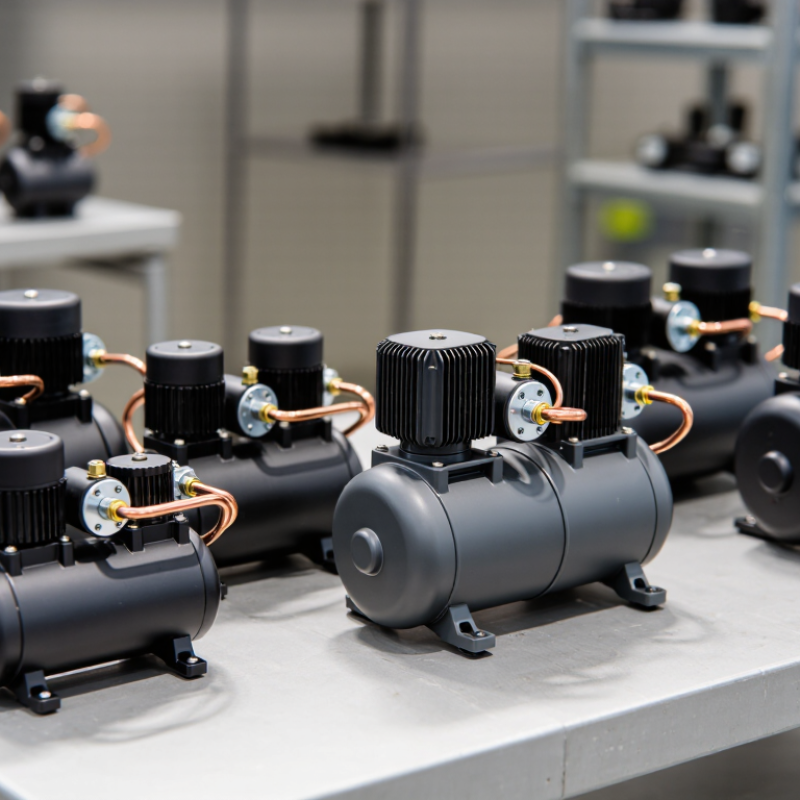
A top mini fridge compressor manufacturer in China proves performance beyond a polished catalog. The IEA’s The Future of Cooling report warns that global cooling demand could more than triple by 2050. Efficiency therefore matters, even in a compact appliance. Buyers should request measured power consumption, cooling capacity, noise levels, and pull-down time at defined ambient temperatures. A compressor that reaches 5°C quickly in a laboratory may struggle beside a hot food truck.
Refrigerant selection also reveals engineering maturity. UNEP’s 2023 Cooling Emissions and Policy Synthesis Report highlights the need for lower-emission cooling technologies and stronger efficiency standards. A reliable manufacturer should explain refrigerant compatibility, oil selection, leakage control, and recovery procedures clearly. It should provide traceable test records, not vague claims. Safety testing aligned with IEC 60335-2-34 is important for compressor assemblies, while ISO 9001 systems can support consistent production.
Factory experience is visible in small details. Look for automated winding checks, clean brazing points, vibration testing, and end-of-line electrical inspection. Ask for samples from different production batches. No factory is perfect. That is useful to remember. A manufacturer that openly reports failure rates and corrective actions may be more trustworthy than one promising zero defects. Technical support after shipment, spare-part availability, and stable lead times often decide whether a compressor becomes a cost or a dependable component.
| Evaluation Dimension | Practical Benchmark for Mini Fridge Compressors | What a Top Manufacturer Should Demonstrate | Why It Matters |
|---|---|---|---|
| Application Capacity | Approximately 20–100 L mini and compact refrigerator applications | A product range covering different cabinet volumes, cooling loads, and installation conditions | A wider range makes it easier to match compressor capacity to the refrigerator design |
| Refrigerant Compatibility | R600a is widely used in domestic and compact refrigeration equipment; other refrigerants may be required by specific designs | Documented compatibility with the selected refrigerant, approved oil, and complete refrigeration system | Correct refrigerant and oil matching supports safety, efficiency, and long-term reliability |
| Electrical Configurations | Common household supply options include 220–240 V at 50 Hz; 100–127 V and 60 Hz versions are also used in some markets | Clear voltage, frequency, starting-current, and protection specifications for each model | Electrical compatibility reduces installation problems and improves export readiness |
| Energy Efficiency | Efficiency must be assessed as part of the complete refrigerator system, not from compressor input power alone | Performance data measured under defined test conditions, with support for applicable energy-efficiency requirements | Cabinet insulation, condenser design, ambient temperature, and controls all affect actual energy consumption |
| Noise and Vibration | Compact refrigerator products commonly target operating noise below approximately 40 dB(A), depending on the complete appliance design | Noise and vibration test reports, balanced moving parts, stable mounting, and consistent process control | Low noise is especially important for bedrooms, offices, hotel rooms, and recreational vehicles |
| Ambient Temperature Capability | Performance should be specified for the intended climate class and operating environment rather than assumed from room temperature alone | Verified cooling performance at the target ambient temperature, including hot-climate conditions when required | A compressor that performs well only in mild conditions may fail to maintain temperature in hot regions |
| Quality and Reliability Testing | Testing should cover start-stop cycling, endurance, electrical safety, leakage, insulation, and abnormal operating conditions | Traceable test records, calibrated equipment, incoming-material inspection, and documented corrective actions | Reliable testing lowers field-failure risk and supports stable product quality over time |
| Safety and Compliance | Relevant requirements may include IEC 60335-2-34 for motor-compressors and IEC 60335-2-24 for household refrigerating appliances | Valid certificates or test reports applicable to the destination market, product configuration, and production site | Compliance documentation supports customs clearance, customer approval, and product safety |
| Customization Capability | Possible customization areas include electrical configuration, mounting arrangement, tubing connection, controller settings, and packaging | Engineering support, controlled drawings, sample validation, and change-management procedures | Customization helps the compressor integrate with different cabinet layouts and market requirements |
| Production Consistency | Key indicators include stable starting performance, cooling capacity, current draw, noise, and dimensional accuracy across batches | Process control plans, serial-number traceability, automated inspection where appropriate, and batch-level records | Consistent batches simplify appliance assembly and reduce warranty-related costs |
| Supply and Delivery Capability | Lead time depends on model availability, order quantity, customization, testing, and shipping destination | Transparent production capacity, realistic lead-time commitments, safety-stock planning, and export packaging controls | Predictable supply helps manufacturers maintain production schedules and inventory levels |
| Technical Service and Warranty | Support should include installation guidance, troubleshooting, performance data, spare-parts information, and warranty terms | Responsive technical communication, clear warranty conditions, root-cause analysis, and after-sales documentation | Strong technical support reduces commissioning time and improves total ownership value |
Note: Performance ranges are general market benchmarks for compact refrigeration applications. Actual selection should be confirmed using the compressor datasheet, complete appliance design, refrigerant choice, climate class, and destination-market requirements.